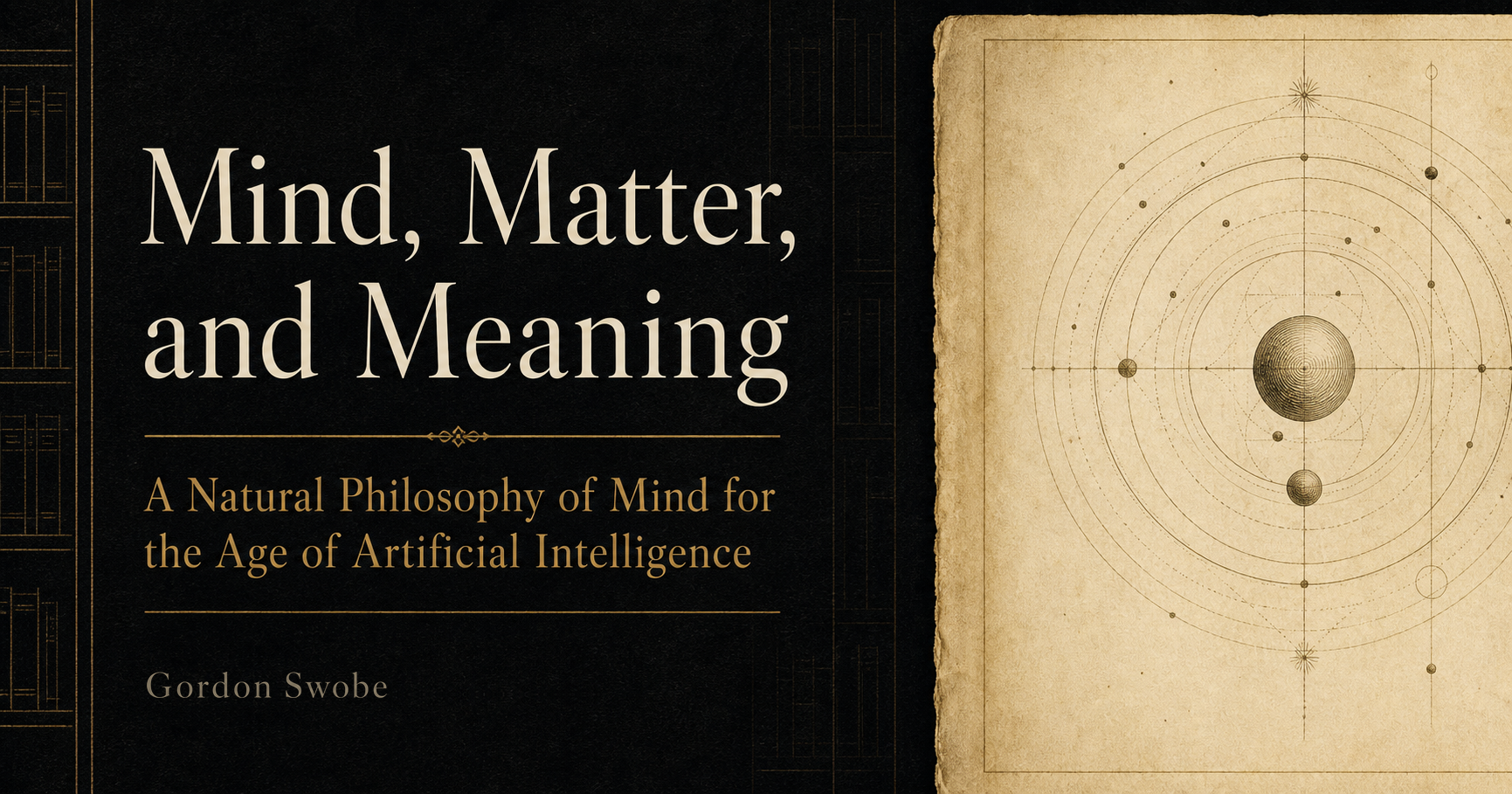

Mind, Matter, and Meaning develops a systematic account of consciousness, perception, intelligence, and linguistic meaning, and applies that account to questions about artificial minds. Drawing on a tradition extending from Aristotle and Aquinas through Brentano, and engaging contemporary figures including Chalmers, Searle, Dennett, Putnam, and Tye, the book examines the conceptual framework that portrays the mind as a private inner domain standing between the subject and the world.
Against this framework, the book defends a reductive, non-eliminative form of a posteriori physicalism together with strong representationalism. It argues that phenomenal character consists in a complete world-presenting representational profile, including content, perceptual or bodily-affective mode, determinacy, field structure, and attention. On this account, perception presents the world rather than internal objects, and the explanatory gap surrounding consciousness reflects a limitation in our concepts rather than an ontological division in nature. The account of meaning likewise treats reference and semantic content as world-involving achievements grounded in causal history, producer–consumer organization, public linguistic practice, and the possibility of error.
The final part considers artificial systems. It distinguishes mechanism-level content, representational competence, bounded and integrated understanding, phenomenal consciousness, and autonomy. Robotics provides a central test case. Neither linguistic fluency nor formal computation alone establishes understanding or consciousness. Robotic embodiment, however, can connect perception, action, and correction across a continuing, world-involving history, strengthening the case for attributing content and some degree of understanding to the system. Any verdict on conscious understanding must consider the causal history, grounding relations, integrative organization, perceptual capacities, and error-sensitive engagement of the particular system.
“Don’t think, but look!”Ludwig Wittgenstein · Philosophical Investigations · 1953
Contents
Preface
On a school field trip in the early 1970s, I met a computer program called ELIZA. It left me with a question about the nature of understanding that has never quite let go.
Introduction
Minds reach beyond themselves to the world — and from that one feature, everything follows. The book’s central argument, distilled.
Part One — Descartes and the Myth of the Inner Theater
How the picture of a mind sealed off from the world got built, and the single thread that begins to unravel it. The same picture, unexamined, is what makes machine consciousness look cheap.
Chapter 1 · The Mark of the Mental
Chapter 2 · How the Inner Theater Was Built
- Read the full chapter →
- 2.1 The Cartesian Tradition
- 2.2 The Empiricist Renovation
- 2.3 How Neuroscience Inherited the Picture
- 2.4 The Same Move in Memory, and in Machine “Memory”
- 2.5 Five Questions, One Picture
- 2.6 The Picture’s Credentials
- 2.7 Indirect Realism and the Invisible Experience
- 2.8 Why the Picture Persists
- 2.9 The Inner Theater, in Place
- Chapter Summary
Chapter 3 · The Argument from Illusion
Chapter 4 · The Transparency of Experience
Part Two — The World-Directed Mind
What experience actually consists in, and why the mystery of consciousness shrinks once you see it — the groundwork without which the machine question cannot be asked well.
Chapter 5 · The Seeing and the Seen
Chapter 6 · The Identity Claim
- Read the full chapter →
- 6.1 The Older Observation: Moore, Brentano, and the Diaphanous Mind
- 6.2 Two Arguments, One Target
- 6.3 The Positive Case: From Transparency to Content
- 6.3.1 The Paint’s Home Turf: Blur, Afterimage, Attention, Imagery
- 6.4 Three Objections
- 6.4.1 Mary’s Room
- 6.4.2 The Inverted Spectrum
- 6.4.3 Inverted Earth
- 6.5 What the Thesis Commits Us To
- 6.6 The Thesis and the Hard Problem
- Chapter Summary
Chapter 7 · The Hard Cases
Chapter 8 · The Knowledge Argument
Chapter 9 · Why Dualism Keeps Winning Arguments It Should Lose
Chapter 10 · The Case Against Panpsychism
- Read the full chapter →
- 10.1 The Disciplined Alternative
- 10.2 Why the Hammer From the Last Chapter Misses
- 10.3 The Convert in the Witness Box
- 10.4 The Dispute Over Sharpness
- 10.5 The Problem That Has Dogged the View Since James
- 10.6 The Idle Wheel
- 10.7 The Strongest Russellian Redoubt
- Chapter Summary
Chapter 11 · The Gap That Isn’t There
- Read the full chapter →
- 11.1 Coffee and the Remaining Question
- 11.2 What Is Really Left Over
- 11.3 The Two Concepts of One Fact
- 11.4 Why an Identity Needs No Bridge
- 11.5 Emergence and Identity
- 11.6 What the Deflation Depends On
- 11.7 Objections
- Objection 1: The phenomenal-concept move cannot explain our whole epistemic situation (Chalmers’s dilemma)
- Objection 2: You have only relocated the gap; it still feels metaphysical
- Objection 5 (the tempting misreading): “So the zombie is impossible, and you’ve proved it here”
- 11.8 The Flip, Made Stable
- Chapter Summary
Part Three — Meaning, Self, and Other Minds
How meaning reaches the world — and where the case about machine meaning begins: information versus meaning, symbol grounding, why a language model’s eloquence is borrowed; then the assembled self, and how one meaner recognizes another.
Chapter 12 · Space, Time, and the Possibility of Reference
- Read the full chapter →
- 12.1 Why Reference Seemed Free
- 12.2 Tokening and Singling Out
- 12.3 The Floor in Three Steps
- 12.4 Objections
- 12.4.1 The mathematician’s numbers
- 12.4.2 The self-sufficient intellect
- 12.4.3 Testimony, Disability, and Unfamiliar Channels
- 12.4.4 The machine that has space and time of its own
- 12.5 A Real Space and Time, and the Attribution Question Left Open
- Chapter Summary
Chapter 13 · The Difference Between Information and Meaning
Chapter 14 · Original Intentionality
- Read the full chapter →
- 14.1 The Thermostat Objection: Registration Without Perception
- 14.1.1 Constancy as the Mark of Perception
- 14.1.2 The Frog’s Subpersonal Machinery
- 14.1.3 A Text-Only Model Has No Constancies to Solve
- 14.2 Derived vs. Original Intentionality: Borrowed Meaning
- 14.2.1 Three Questions That Keep the Achievements Apart
- 14.2.2 What Training Selects
- 14.2.3 Mechanism Content and Whole-System Understanding
- 14.3 Dependence Without a Semantic First Mover
- Chapter Summary
Chapter 15 · Teleosemantics — Where Meaning Comes From
Chapter 16 · Language and the World
- Read the full chapter →
- 16.1 One Sentence, Several Achievements
- 16.2 Sense, Reference, and Empty Expressions
- 16.3 How Sentences Build Meaning
- 16.4 Meaning in Use
- 16.5 What Speakers Do with Words
- 16.6 How Language Reaches the World
- 16.6.1 The conceptual-role objection
- 16.6.2 The empty-expression objection
- 16.6.3 The inherited-reference objection
- 16.7 When a Machine Uses Language
- 16.7.1 The other-minds objection
- Chapter Summary
Chapter 17 · The Assembled Self
Chapter 18 · The Nature of Free Will
Chapter 19 · The Problem of Other Minds
Part Four — Artificial Intelligence
What all of this says about machines: why command of form, however fluent, never reaches the world that meaning requires — and what a system would actually need before the verdict could change.
Chapter 20 · Functionalism and Computationalism
- Read the full chapter →
- 20.1 What Functionalism Got Right
- 20.2 Why Narrow Functionalism Fails
- 20.3 Why Computationalist Multiple Realizability Fails
- 20.4 Three Tests of the Wide View
- 20.4.1 Block’s Homunculus Nation
- 20.4.2 Has Functionalism Merely Changed Its Name?
- 20.4.3 Organizational Invariance
- 20.5 The Background No Rule Contains
- 20.6 The Door to the Room
- Chapter Summary
Chapter 21 · The Infamous Chinese Room
- Read the full chapter →
- 21.1 The Argument in Its Strongest Form
- 21.2 The Standard Replies, Each in Its Strongest Form
- 21.2.1 The Systems Reply
- 21.2.2 The Robot Reply
- 21.2.3 The Brain Simulator Reply
- 21.2.4 The Combination Reply
- 21.2.5 The Other Minds Reply
- 21.3 From the Room to the Model
- 21.4 What the Room Does Not Show, and What Would Pass It
- Chapter Summary
Chapter 22 · Simulation and the Observer
- Read the full chapter →
- 22.1 The Move the Last Chapter Left Open
- 22.2 The Wall That Allegedly Runs Any Program
- 22.3 The Best Repair, Granted and Set Aside
- 22.4 What the Wall Lacks
- 22.5 What the Model Does and What the Storm Does
- 22.6 Simulability Is Not Realization
- 22.7 The Perfect Brain, and What It Still Lacks
- 22.8 The Objection That Takes Mind to Be the Exception
- Chapter Summary
Chapter 23 · Form Without World
Chapter 24 · The Conscious Robot
Chapter 25 · The Anthropomorphic Reflex
Closing
What you get back once the mind is no longer sealed inside — and why a consciousness located within nature is the more astonishing result, not the consolation prize.
Coda · The Marvel of Conscious Existence
The Singularity has arrived as an appearance, not a metamorphosis: what to expect as machines seem conscious, how we could ever know, and how society will cope.
Back Matter
The scholarly apparatus behind the spine — the load-bearing thought experiments and the demoted deep-dives at full strength, for readers who want them.
Appendix A · The Perception Arguments: Deep Dives
Appendix B · Scholarly Excurses
- Read the full chapter →
- B.1 Inner Speech and the Vygotskian Story
- B.2 Information Talk Is a Metaphor
- B.3 The Conceivability Trap
- The argument in its exact form
- What the intuition tracks
- Two responses worth naming
- B.4 The Church–Turing and Church–Turing–Deutsch Theses
- B.5 Color and the Reflectance Account
- B.6 The Two Objections to the Mark
- The Mood That Looks Like a Counterexample
- The Monster That Isn’t There
- B.7 Emergence: The Wrong Question, Extended
- B.8 The Phenomenal-Concept Dilemma
- B.9 Swampman and the History Requirement
- B.10 Tye’s Sharpness Argument and the Concept/Property Dispute
- B.11 Functionalism’s First Two Replies
- Objection 1: Bite the Bullet
- Objection 2: You Have Only Renamed the Mystery
- B.12 The Stake: Sources of a Term
- The causal-success objection
- Where the system ends
- B.13 The Ladder of Distinctions
- B.14 Why Restorability Is the Wrong Criterion
- B.15 Teleosemantics: The Technical Rounds
- Round Three: What fixes fly, if anything?
- Round Four: Does training supply a selection history?
Works Cited
About
I write about perception, language, and consciousness — what it means to experience the world, and why most philosophical accounts of that have gone astray. More about the project →
If you’d like to get in touch — an objection, a citation, an argument I’ve missed — use the contact form.